
Indian equity benchmark indices Sensex and Nifty plummeted over 2 per cent following US President Donald Trump's declaration that the interim agreement with Iran is 'over', which led to a sharp rally in crude oil prices and heightened geopolitical tensions.

Indian benchmark equity indices, Sensex and Nifty, saw a rebound in early trade, driven by a rally in global markets and easing Brent crude oil prices, with hopes of US-Iran peace negotiations also contributing to investor optimism. Track Sensex, Nifty on May 22
The Indian rupee rebounded 50 paise from its all-time closing low to settle at 96.36 against the US dollar, driven by retreating crude oil prices, signs of easing geopolitical friction, and likely central bank intervention.

Indian benchmark indices Sensex and Nifty recorded their third consecutive day of gains, primarily driven by an over 8 per cent surge in Bajaj Finance following strong Q1 FY27 results, coupled with significant foreign fund inflows and a dip in crude oil prices.
Indian equity markets experienced a volatile session, with the Sensex and Nifty recovering some ground after a significant plunge the previous day. Gains were driven by PSU bank, IT, and metal stocks, but concerns over rising fuel prices and geopolitical tensions limited the recovery.

Stock markets rebounded on Friday with the benchmark Sensex closing higher by 316 points after heavy buying in banking and metal shares amid optimism over trade deal progresses and India's participation in Pax Silica.

Indian markets on Dalal Street rallied sharply as easing tensions in the US-Iran conflict and stable oil prices boosted sentiment. Track Nifty 50 and BSE Sensex performance and key global triggers.

Indian benchmark indices, Sensex and Nifty, extended their losses for a second consecutive day, primarily due to HDFC Bank's disappointing quarterly earnings and escalating tensions in West Asia, coupled with persistent foreign fund outflows.

Listed capital market companies in India delivered strong fourth-quarter earnings growth, with a universe of 12 firms posting 30 per cent year-on-year revenue growth and 19 per cent earnings growth in Q4FY26, despite mark-to-market (MTM) losses impacting headline profitability for some.

'The market is currently neither cheap enough to be exciting about nor expensive enough to worry about.'
India's trade deficit reached a six-month high of $31.98 billion in July, driven by a sharp increase in imports, particularly crude oil, electronic goods, coal, and fertilisers. Both merchandise exports and imports recorded their second-highest levels during the same period.

Indian markets on Dalal Street rallied sharply as easing tensions in the US-Iran conflict and stable oil prices boosted sentiment. Track Nifty 50 and BSE Sensex performance and key global triggers.

Indian benchmark indices, Sensex and Nifty, closed higher, primarily driven by bank stocks and encouraging US inflation data, which fuelled expectations of a less aggressive Federal Reserve monetary policy. However, escalating US-Iran hostilities tempered investor sentiment, leading to some profit-taking.

'Once the market decides it wants to go up, it goes up -- no amount of bad news can really hold it back.'
Indian benchmark indices Sensex and Nifty closed lower, snapping a two-day rally, as a spike in crude oil prices, triggered by reports of fresh US military operations in southern Iran, dampened investor sentiment and reignited fears of renewed energy supply disruptions.

The BSE benchmark traded 44.43 points up at 76,521.93, and the Nifty quoted 17.20 points higher at 24,048.85. Track Stock markets on May 26.

Indian stock markets extended their gains for a third consecutive day, with the Sensex climbing 753 points and the Nifty closing above 24,550, driven by a drop in crude oil prices and optimism surrounding potential peace talks between Iran and the US.

Indian stock market benchmarks Sensex and Nifty closed higher on Tuesday, buoyed by a drop in crude oil prices, a rally in global markets, and strong buying in IT stocks.
Indian benchmark stock indices Sensex and Nifty rebounded nearly 1 per cent, snapping a three-day decline, driven by rallies in Reliance Industries and Sun Pharma, alongside positive global market trends and easing geopolitical tensions.

Analysts predict that the ongoing conflict in West Asia, crude oil prices, and global trends will significantly influence the Indian stock market in the upcoming holiday-shortened week. Foreign investor activity and rupee movement will also be crucial.

Indian Hotels Company (IHCL) reported a 20.8 per cent year-on-year rise in net profit for Q1 FY27, reaching 357.9 crore, despite macroeconomic headwinds like geopolitical tensions in West Asia impacting international travel and airline catering business.
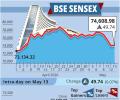
Indian benchmark equity indices, Sensex and Nifty, closed marginally higher, breaking a four-day losing streak, despite elevated crude oil prices and ongoing geopolitical uncertainties. The market saw a temporary pause in panic selling, though cautious sentiment persists.

Indian benchmark indices Sensex and Nifty experienced volatility due to conflicting developments in West Asia, including reports of the Strait of Hormuz closure, which led to a rebound in crude oil prices and heightened investor concerns about supply disruptions and inflation.
Indian benchmark equity indices, Sensex and Nifty, extended their winning streak for a third consecutive day, driven by a rally in IT stocks and global cues suggesting a more accommodative monetary policy after softer-than-expected US jobs data.

Trent reported a 20 per cent revenue rebound in Q4FY26, driven by a recovery in like-for-like growth and significant store additions. The company's board has approved raising up to 2,500 crore in equity to fund investments in store network upgrades, new brands, supply chain automation, and Star Bazaar expansion, alongside a 1:2 bonus issue and a 6 dividend.

Indian stock market benchmarks Sensex and Nifty rebounded strongly after a two-day decline, driven by falling crude oil prices and positive global cues amid hopes of de-escalation in the Middle East.

Indian equities on Dalal Street saw volatility. Track Sensex, Nifty50 movement and key market drivers for Feb 25, 2026.
Indian benchmark indices, Sensex and Nifty, closed almost unchanged in a volatile session as investors reacted cautiously to mounting geopolitical headwinds and a significant jump in crude oil prices, with Brent crude surging to USD 94.68 per barrel.
A day after suffering their worst session in about two years, benchmark indices Sensex and Nifty rebounded up to 2.5 per cent on Friday, in line with higher global markets as the US and allies put up a united front to punish Russia with harsher sanctions over the Ukraine conflict. Snapping their seven-day losing streak, the BSE Sensex climbed 1,328.61 points or 2.44 per cent to settle at 55,858.52, while the NSE Nifty went soared 410.45 points or 2.53 per cent to 16,658.40. Barring HUL and Nestle, all Sensex shares closed with gains -- with Tata Steel, IndusInd Bank, Bajaj Finance, NTPC and Tech Mahindra surging as much as 6.54 per cent.

A potential US-Iran peace deal, expected to be signed on June 19, is anticipated to ease geopolitical stress and benefit various sectors, particularly in India, with analysts suggesting investors await finer details before making significant moves.

Indian benchmark stock indices Sensex and Nifty rebounded, closing over 1% higher, mirroring a global equities recovery after recent losses due to geopolitical tensions.

Streaming has globalised the entertainment industry, enabling artists like Diljit Dosanjh and Arijit Singh to reach diverse international audiences.

The Indian rupee rebounded against the US dollar following intervention by the Reserve Bank of India, amidst ongoing concerns about foreign capital outflows, rising crude oil prices, and geopolitical instability.

'The real money in India over the coming period is likely to be made in small-cap stocks rather than in the large-cap benchmark names.'

Financial year 2025-26 (FY26) saw a significant shift in corporate fundraising, with rights issues more than doubling to a multi-decade high of 51, raising 44,290 crore, while qualified institutional placements (QIPs) more than halved to 29 issues, mobilising 62,954 crore, driven by sharp equity market corrections and regulatory changes.

Foreign investors have withdrawn a record Rs 1.14 lakh crore from Indian equities in March, driven by geopolitical tensions, a weakening rupee, and concerns about crude oil prices.

Indian stock market indices Sensex and Nifty closed nearly 1 per cent higher, marking their third consecutive day of gains, supported by a slight decrease in crude oil prices and positive global market trends.

Indian IT stocks have seen a significant decline of up to 33 per cent year-to-date in 2026, largely due to artificial intelligence (AI) disrupting traditional outsourcing models, leading analysts to predict a challenging FY27 for the sector despite some cushion from rupee depreciation.

India's leading passenger vehicle manufacturers are significantly increasing investments and factory capacities, alongside planning major product launches for FY27, driven by strong confidence in sustained domestic demand growth despite global geopolitical tensions and supply chain risks.

Heartingly, the Nifty ended just shy of the 5,000 mark at 4,990, up 20 points. The market breadth turned positive as well. Out of 2,838 stocks traded, there were 1,473 advancing and 1,286 declining stocks.
